
LAOS - THE LAND OF GENTLE STILLNESS
Written by
Manager
Publish on
30 tháng 11, 2025


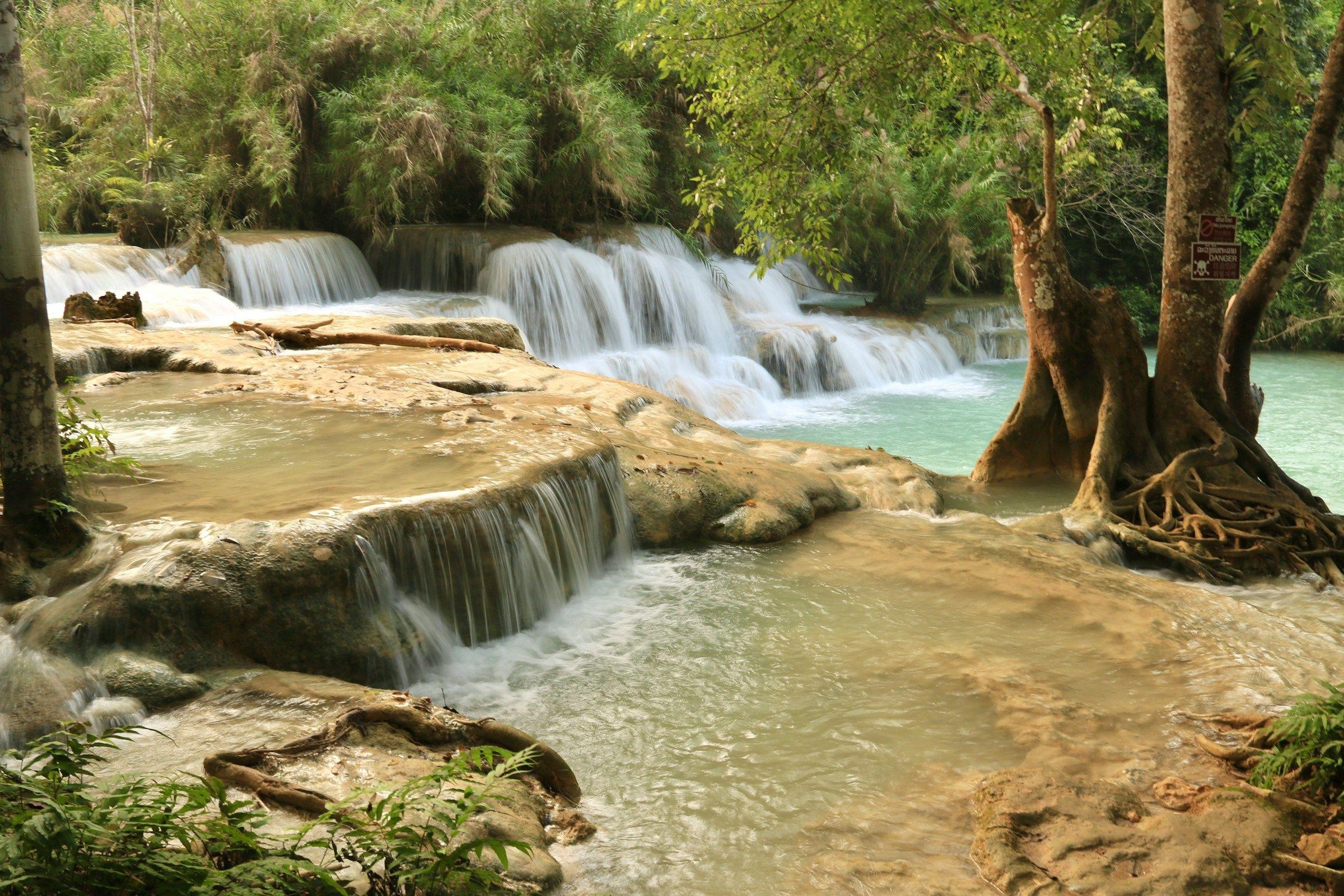
In Laos, things are slow and calm, and people do not rush. This is the land of limestone mountains, jade blue waterfalls, monks in orange robes, where the pulse of town life flows next to the flow of the Mekong River, and people live peacefully near street stalls and flowers. Northward, in areas like Thalat and Vang Vieng, hills become taller, and there is more greenery.
There is Luang Prabang, a calm town dotted with old temples and wooden houses, where there are many young monks staying in pagodas to study.
Then you reach Luang Prabang, a quiet town with old temples and wooden houses. In the morning, you can hear birds and see monks collecting food. At night, the smell of cooked rice and grilled fish fills the air. In Vientiane, the capital, the streets are wider, with more temples, more cafes, more pulse of political and social feel. In Thalat, a small town near a reservoir, there is a calm, big lake named Nam Ngum, and here there are many fishing boats and floating restaurants. In Vang Vieng, the land is bigger and there is more greenery, with vast limestone mountains behind rice fields, the Nam Song river running through the town, carrying people playing with kayaks, and hidden somewhere are blue lagoons.
TOPOGRAPHY
Lao’s topography is varied, and its textures and shapes change gradually as one gradually moves northward. The capital, Vientiane, lies on a flat plain on the side of Mekong river, its soil built up through many centuries, when floods accumulate alluvial. This fertile, abundant land helps rice fields grow fast. In the North, Thalat is quiet. Its topography is marked by Nam Ngum lake, a man-made reservoir, embraced by soft hills and dry land areas. There are soft hills, forested ridges, creating an ambience of quiet and calmness. Vang Vieng, on the other hand, has a dramatic terrain. Here, the land is filled with karst landscape, with limestone cliffs, deep caves, and the Nam Song River flowing past rice fields and village roads. In the north, Luang Prabang is surrounded by forested hills, and Mekong and the Nam Khan rivers. Altogether, these provinces have a combination of river plains and rugged highlands, and the space here changes in a layered way.
HISTORYThe history of Laos is the history of kingdoms, colonizations, and many types of conflicts. In the 14th century, Luang Prabang was the royal capital of the Kingdom of Lan Xang and was the beginning of Lao’s identity. For many centuries, it was a hub of culture and politics, and along the Mekong river people built temples and palaces. During the 16th century, the capital became Vientiane. In the 18th century, the Siamese invaded Vientiane, destroying many sections of the city.
In the 19th century, together with Vietnam and Cambodia, Laos became part of Indochina, and many influences of architecture still leave their traces in the layout of streets and in some specific sites. In the 1970s, the Nam Ngum Dam was built and Thalat grew around this site - one of the first significant projects, playing a key role in Lao infrastructure. Vang Vieng was like a stopover town, and both the French and Americans used it as a base of logistics. To travel into and past these towns is to feel layers of kingdom, colonialism, as well as new development and current ways of life.
CULTURE
Lao’s culture is greatly influenced by Buddhism, and where monks, temples, and buddhist festivals form the textures and spirits of spiritual, even daily life. The branch of Buddhism here is Theravāda Buddhism, where followers practice their discipline, meditation, wisdom, and where monks play a central role in the social life - people give them daily alms, and monks guide the spiritual life. People practice traditional arts and handicrafts, such as weaving, wood carving, and dance. In Vientiane, the culture is a bit more mixed. While it’s still deeply Buddhist, the capital also shows influences from French colonial times — in food, architecture, and even café culture. Thalat is a small lake-side town, with a quiet, rural atmosphere. Here, activities revolve around fishing, farming, and modest daily activities. In Vang Vieng, the town embraced by misty karst mountains and the peaceful Nam Song River, there is a blend of the spirit of Buddhism and the colorful, well-preserved practice of Hmong and Khmu villages nearby.
ATTRACTIONS
VIENTIANE
Vientiane is Laos' capital city. It is also quiet and calm similar to other cities of Laos, but here, streets are more orderly, there are more cultural and political clusters, blended with old French colonial buildings. It is next to the Mekong river, with various wet markets, peaceful temples, and consistent daily activities. In the 16th century, Vientiane was chosen by King Setthathirath as the capital, replacing Luang Prabang. That Luang stupa, the iconic structure, was built. Between the 19th and 20th century, under the rule of colonial France, there were big changes in architectural sites and layout of Vientiane. After many political conflicts, in 1975, the city turned into an administrative and economic core of the Lao People's Democratic Republic. In this city, Theravāda Buddhist’s ways of life blend with traditional Laos culture and some relics of colonial French. Here, there are beautiful architectural sites - the Pha That Luang, the Patuxai arch, the tranquil Wat Sisaket, and even a unique Buddha Park outside the city territory.
VANG VIENG
Vang Vieng is a city of striking nature. There are tall limestone mountains, flat rice fields, and quirky towns nestled next to the Nam Song River. In this area, there are so many caves in jungle clusters, with sparkling walls, cool underground water currents, and used by some Buddist to practice. In the rainy season, Vang Vieng is green and lush, with many plants hanging on rocks, birds singing, and the slow rhythm of nature.
In the 2nd Indochina War, Vang Vieng turned into a key site, used by American forces as an airstrip. Travel industry grew in a wild way, then controlled better by the government, hence helping preserve its nature and culture.
The culture of Vang Vieng is a mix of Lao and Hmong’s ways of life, manifested in seasonal festivals and spiritual practice. There is Tham Phu Kham cave containing a reclining Buddha, rice paddies, karst hills, making the terrain landscape varied and dramatic.
LUANG PRABANG
Luang Prabang is peaceful yet elegant. Here, charming cafes, restaurants, hostels, rustic French colonial villas dot alongside each other, and monks wearing saffron robes walk along tree-lined streets every morning. The city is at the congruence of Mekong and Nam Kham rivers, embraced by green hills, and life moves at a peaceful pace. There is sunset along the Mekong River. For many centuries, Luang Prabang was the royal capital of the Kingdom of Lan Xang. Even when the center moved to Vientiane in the 16th century, it was still a significant spiritual and cultural hub. In 1995, the city was designated by UNESCO as a World Heritage Site, for its smooth blend of traditional architecture and well-preserved European influences, in a way that suits well with nature and culture. The city was a royal and religious center for many centuries, and here, temples dot in peaceful resident settlements, and monks wearing saffron robes are an integral part of daily life.In terms of culture, the city blends Theravāda Buddhist traditions with the customs of Laos. There are so many beautiful sites here, such as the gilded Wat Xieng Thong, Mount Phousi, the old Royal Palace, and a night market selling various types of street food and trinkets alongside the Sisavangvong Road. Here, the ambience is quiet, calmed by the river, lifted in reverence towards its signals of spirituality.
Written by
Manager
Share this post